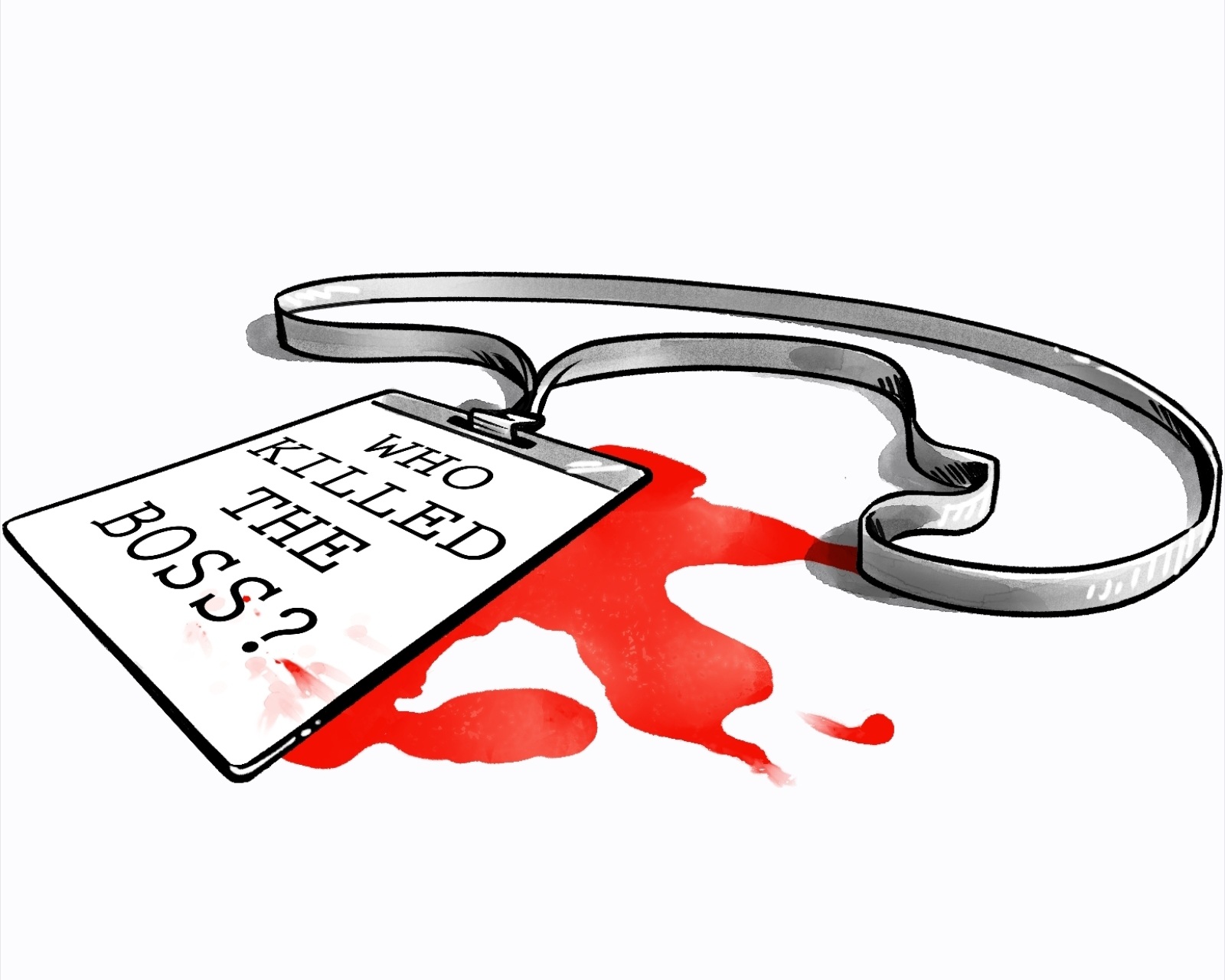
Who Killed the Boss?
On Quisicosas since 18 November 2026
What it is about
The boss is dead, and everyone's a suspect. Can you find the killer in time? Players: 3-5 Ages: 9+ Playing Time: 20-30 minutes OBJECTIVE Be the first to work out who is holding the "You Killed the Boss" card—or trick someone else into accusing the wrong person. SETUP Download the PDFs and print them out. Cut along the bold lines, fold along the dotted lines, and add glue or tape if required. Give each player a Clue Tracker, a pencil and an eraser. Shuffle the Evidence cards and deal 2 face-down to each player. All players can look at their own cards, secretly. Whoever received the "You Killed the Boss" card is the killer for this round. Leave any unused cards face up on the table. (NOTE: if one of them is the "You Killed the Boss" card, that means you don't have a killer! Shuffle all the cards and deal them again.) You're ready to start! HOW TO PLAY The game is played over multiple rounds. The player who has worked in their current job for the longest goes first, then play continues clockwise. On your turn you must do ONE of the following: Ask to See an Evidence Card Choose any other player and name a specific evidence card, e.g. "Alessa, do you have the Archive card?" If they have the card you asked about, they MUST show it to you, privately (no one else may see it). If they don't have that card, they must show you one of their other Evidence cards privately. After one question, your turn is over. NOTE: You cannot ask about a card that is already in your hand, and you cannot ask about the "You Killed the Boss" card. Make an Accusation Point to any other player and accuse them of being the killer. NOTE: You cannot accuse yourself, and if you are the killer, you cannot make any accusations. You may only ask to see Evidence cards. AFTER AN ACCUSATION All players reveal their evidence cards. If your accusation was correct , you earn 1 point. If you were wrong , the killer earns 1 point, and so does the person who was wrongly accused. Either way, the round is over. All the evidence cards are shuffled and redistributed. The player to the left of the previous starting player goes first in the new round. The first player to earn three points wins! In the event of a tie, play an extra round. STRATEGY Every question yields several clues. For example, if you ask Harvey about the Rooftop card, and he shows you the Fire Door card instead, you've learned several things: That Harvey doesn't have the Rooftop card That he does have the Fire Door card. That no other player has the Fire Door card (because Harvey has it) But the other players have also learned something about your hand (you don't have the Rooftop card). Using the Clue Tracker, it's possible to find the killer by a process of elimination. But since you're racing the other players, you may have to accuse before you're 100% sure. Pay attention to the behaviour of your suspects. Nervous or evasive players might be hiding something (or they may be hoping you'll falsely accuse them, and they'll be compensated with a point). If you're the killer, all you can do is try to deflect suspicion onto others, and try not to ask questions you obviously know the answer to. QUICK REFERENCE Your Turn Options: Ask any player about a specific evidence card (not the killer card, not a card you have) OR Accuse another player of being the killer (unless you ARE the killer) Scoring: Correct accusation = 1 point to accuser Incorrect accusation = 1 point to killer, 1 point to the wrongly accused person. First to 3 points wins! Can you solve the mystery before the killer fools everyone? Good luck, detective! ~ Massive thanks to everyone who helped with playtesting, especially Holly Bidwell, Catherine Hiccups, Shane W. Smith and my family!