What it is about
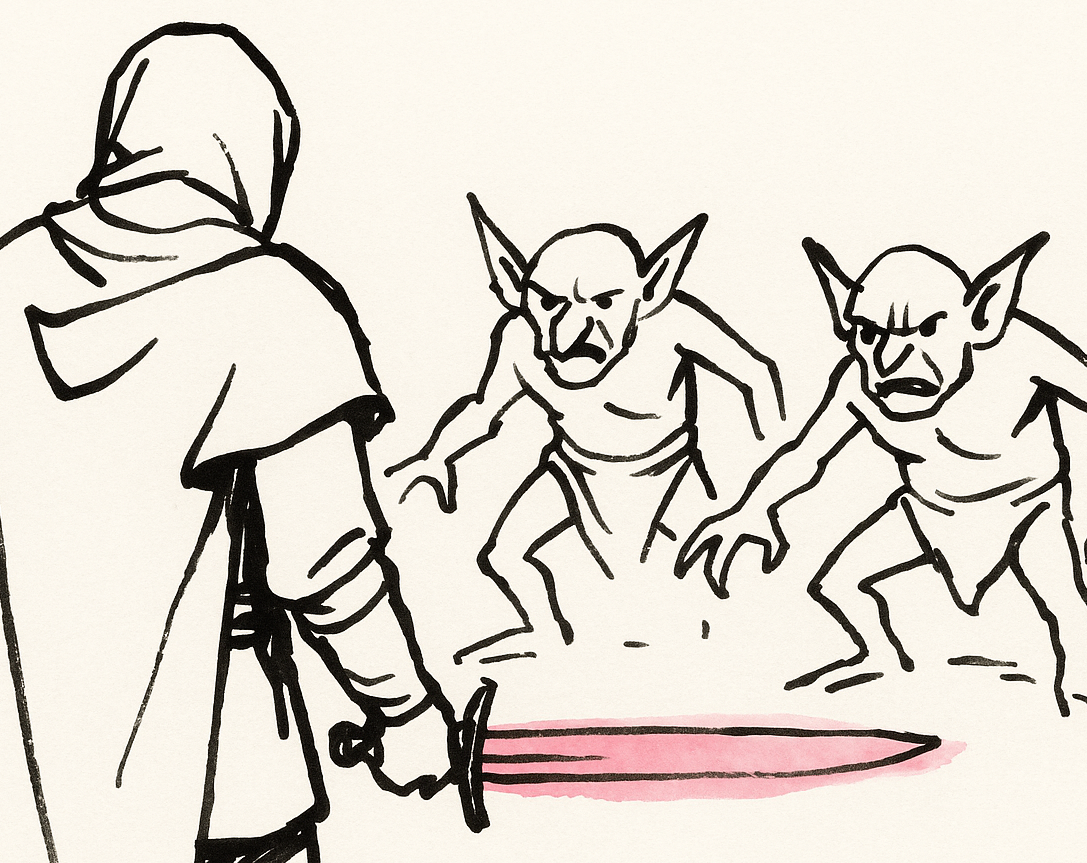
This card set is part of the battle mechanism of another card game I've created called "Atop His Pyramid, Gone Mad". This smaller set of cards works perfectly as a kind of rock-paper-scissors in four different levels and can be played in several ways. This is the basic logic: one player uses the neutral weapon cards, the other, the goblin cards. The interactions are: sword defeats shield, shield defeats spear, which defeats sword. water defeats fire, fire defeats wood, which defeats water. That's the first level. However, elements can be elevated to another level: water becomes ice, fire becomes light, wood becomes steel. When upgraded, elements invert the relations of the lower level, while defeating their lower level and the element they used to lose to, but losing to the element they used to beat. For example. Water upgrades to ice, which loses to fire, but defeats both water and wood. Relations inside the second level are: light defeats ice, ice defeats steel, steel defeats light. The dagger, bow and arrow, and battle axe cards work thus: the dagger is the upgrade of the shield, the bow is the upgrade of the sword and the battle axe is the upgrade of the spear. So similarly to elements, they defeat their unupgraded version, while inverting the original relations both in their own level and in the previous level. For example: while the dagger defeats the sword and the spear, it loses to the bow and arrow. Dagger defeats axe, axe defeats bow and arrow, bow and arrow defeats dagger. The differentiated colors, orange, teal and pink, mean those weapons are "legendary". As a result, in interacting with other weapons, they function as the upgraded version of whatever element they're fighting. Against water, they count as ice; against fire, they count as light; against ice, they count as ice; against light, they count as light. Magic wands just cause a tie whenever used, against any weapon (or other magic wands). The best way to play with these cards that I could come up with is this: Two players alternate placing four cards on the table, in a row opposite the other player's row. It's a battle formation with a one-row no-man's land in the center. When a card moves into the no-man's land, another card takes its place in the battle line. In the no man's land, cards battle each other, and thus disappear one by one. If there's a tie, the defending card has the advantage. If a card in the no man's land moves laterally and its own battle line is complete, the card below it on the battle line takes its place, and is thus replaced itself by a card in the player's hand. In most cases, this will mean a defeat of the other side. If one player takes his card to the battle line of the other and the defending player does not have at least one card that can defeat it, he loses the game. The full version of this battle mechanism includes more than double the number of cards, as it makes sense for a larger game to have a more complex battle system, but this smaller subset is perfect for duels between two players, at least in my experience.