What it is about
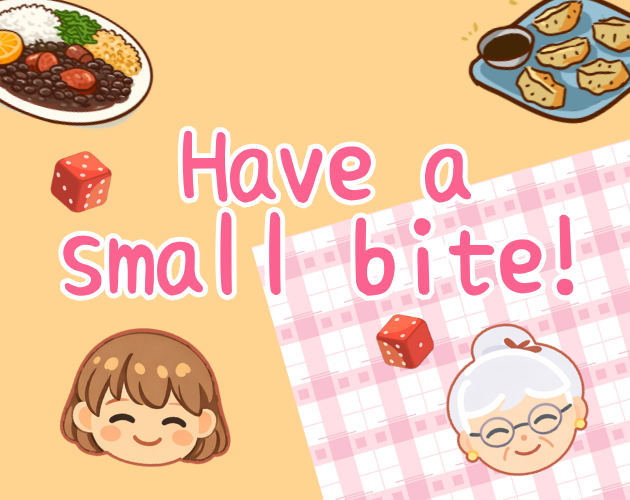
You know that feeling when you were a kid at your grandma’s house, and she kept trying to feed you? You were completely full, but somehow you just couldn’t say no? Have a small bite! is exactly about that. A cozy competitive board game about the dynamics between grandmas and their grandchildren. They often communicate their love aggressively through food, and the children often struggle to say no. This is a two-player game , there are two characters: the Grandma and the Kid. The Kid’s goal is to get to the end of the game without getting full, while Grandma’s goal is to feed the kid 6-8 points of food. If the uncomfort meter or the food meter gets to its maximum, the game is over and no one wins. Have a small bite! FOOD Our game team members are from Brazil, China, and Colombia, so our food cards also have food from these regions. These are all experiences that we shared with our grandmom Grandma & Grandchild Well... we have different reasons RULES Game Overview: Have a small bite is a cozy two-player strategy game where you play either a grandma trying to feed her grandchild or the grandchild trying to make grandma happy and not get a bad stomach ache from all that food. The game is played over one meal, composed by three rounds. Each round is a moment in the meal: appetizers, main course, and desert. Grandma wants to feed her grandchild and the grandchild does not get too full; both are trying to not make this moment uncomfortable. Game Components: ( see illustration below) Board Discomfort tracker Food and beverage cards Grandchild cards Grandma cards Food points Dice Setting up the table : (see illustration on page 1) Separate the grandma, grandchild, the food (appetizers, main course, and deserts) and the beverage cards. Decide who will be the grandma and who will be the grandchild. Take the corresponding cards, leave them face down in front of you. Each player now takes 5 cards from their respective pile, these will be their starting hand. Take the board and place it in front of you, where both players can reach it. After shuffling the cards, place the 4 piles of food cards close to the board. Take the food points and place them in a pile you can easily access. Place the discomfort tracker next to the board. Objective : grandma >span class="a_GcMg font-feature-liga-off font-feature-clig-off font-feature-calt-off text-decoration-none text-strikethrough-none">is to feed the grandchild. Get the food counter to 6-10 until the end of the three rounds. grandchild >span class="a_GcMg font-feature-liga-off font-feature-clig-off font-feature-calt-off text-decoration-none text-strikethrough-none">can eat some, but if they go over 5 food points on the food counter until the end of the three rounds, they will feel too full and they will lose. Both players are trying to keep the situation from being awkward, because if the discomfort tracker reaches 10 at any point , that means the relationship is under a lot of tension and both players lose . Food Counter Discomfort Tracker Turns : During your turn you have two options: play a card or change your cards. To play a card you must read the title out loud and then place it on an available spot on the board to the right of the card you want to affect (see illustration below). Cards affect only cards on the same row unless otherwise specified. Then the effects of the card will come into action. If the card you play has a discomfort modifier (go to “how to read a card”) then move the discomfort tracker the amount indicated on the card. If the card involves a beverage being brought into play or being modified, it must be played in the beverage section. Important : if the text is not read out loud or the action indicated on the card is not performed, then the card is invalid and its effects are cancelled. After playing a card, you must draw another card from your pile. Example: The grandchild wants to reject the food card on the second row. They must play their card on the space right next to that food card. (see illustration below) Turns ( continuation): To change your cards , place your current hand into your card pile and shuffle the whole pile. Then deal yourself 5 new cards , these will now be your new hand. If you change your cards, you may not play a card on the same turn. Rounds: The game is played over 3 rounds: Appetizers, Main Course, and Desserts. First round : take 3 random cards from the Appetizers pile and place them on the first column of the board (see illustration below), leaving 9 spaces and the beverages spaces free. Check “Turns”. Place the food points indicated on the card on top of the cards. Once all 9 spaces are full or there are no more possible legal moves , the round is over and all remaining food points are added to the food counter on the bottom right corner. Example: The round has finished and there were two food points on top of the food cards on the board. These foodpoints must now be moved to the food counter. (see illustrations below) Second round : remove all played cards except the Appetizer cards . Turn the Appetizer cards over to indicate that those spaces are no longer available. Place the food points indicated on the food cards on top of the food cards. (see illustration below) Take the 3 cards from the top of the Main Course pile and place them on the second column, leaving 6 spaces and the beverages spaces free. (Illustration below) Once all 6 spaces are full or there are no more possible legal moves, the round is over and all remaining food points are added to the food counter. Third and final round: remove all played cards except the Appetizer and the Main Course cards. Turn the Main Course cards over to indicate that those spaces are no longer available. Take 3 random cards from the top of the Desserts pile and place them on the third column, leaving 3 spaces and the beverages spaces free. Once all 3 spaces are full or there are no more possible legal moves, the round and the game are over. Move any remaining food points to the food counter on the bottom right corner. If there are less or equal to 5 food points on the food counter, the grandchild wins. If there are more than 5 food points on the food counter, the grandmother wins. How to read a card: Food cards (see illustration below) : The food points: this indicates how many food points this card will add to the food counter, place that amount of food points on top of the card. Special information about the card, the symbols on the top right corner will indicate information regarding ingredients. .Name of the dish Short description or insights into the dish, from the grandchild’s perspective. Special properties of the card and what it does. (Only certain cards) The example below shows two different food cards. The food points in each one are different as are the symbols on the top right corner (see explanation for symbols below). The card on the left also has special properties that the card on the right does not have. How to read a card (continuation) : Grandma and Grandchild Cards (see illustration below) : Discomfort or Food points effect: indicates how the discomfort level varies (see discomfort tracker explanation below) with the card or how many food points are added. Title: This part of the card must be read out loud for the card to be played. Special properties of the card and what it does. Short expansion on the card, from either the grandmother’s or the grandchild’s perspective. How to read a card (continuation) : Example: the grandmother played the card below. As we can see, the top left corner shows a modifier for the discomfort tracker. In this case we are increasing the discomfort level by 1. Addionally, the special property of this card indicates that it can make any food card a favorite , meaning it cannot be eliminated from the table. The granma must now increase the discomfort level in the tracker by 1. (see illustration below). Example: The grandchild place the card below. As indicated by the dice, symbol both players must now roll the a die and the highest number wins. In this case, if the grandmother wins, this card is discarted and will not be on the board; if the grandchild wins, this card’s effect applies and ist is left on the board. This card also affects the discomfort tracker, so the grandchild must inscrease it. How to read a card (continuation) : Example: the grandmother played a card with the beverage symbol (see image below). The grandmother must now take the top card from the beverage pile and place it on the beverage section of the board. TIP: Some of the beverage cards will add food points and some beverage cards will remove foodpoints, so it is not always a good strategy for the grandmother to add beverage cards. Here are the PDFs You can print and cut them out by yourself, and play our games