Zoo Better
On Quisicosas since 20 December 2025
Featured in the newsletter of
20 December 2025 (on Substack)
What it is about
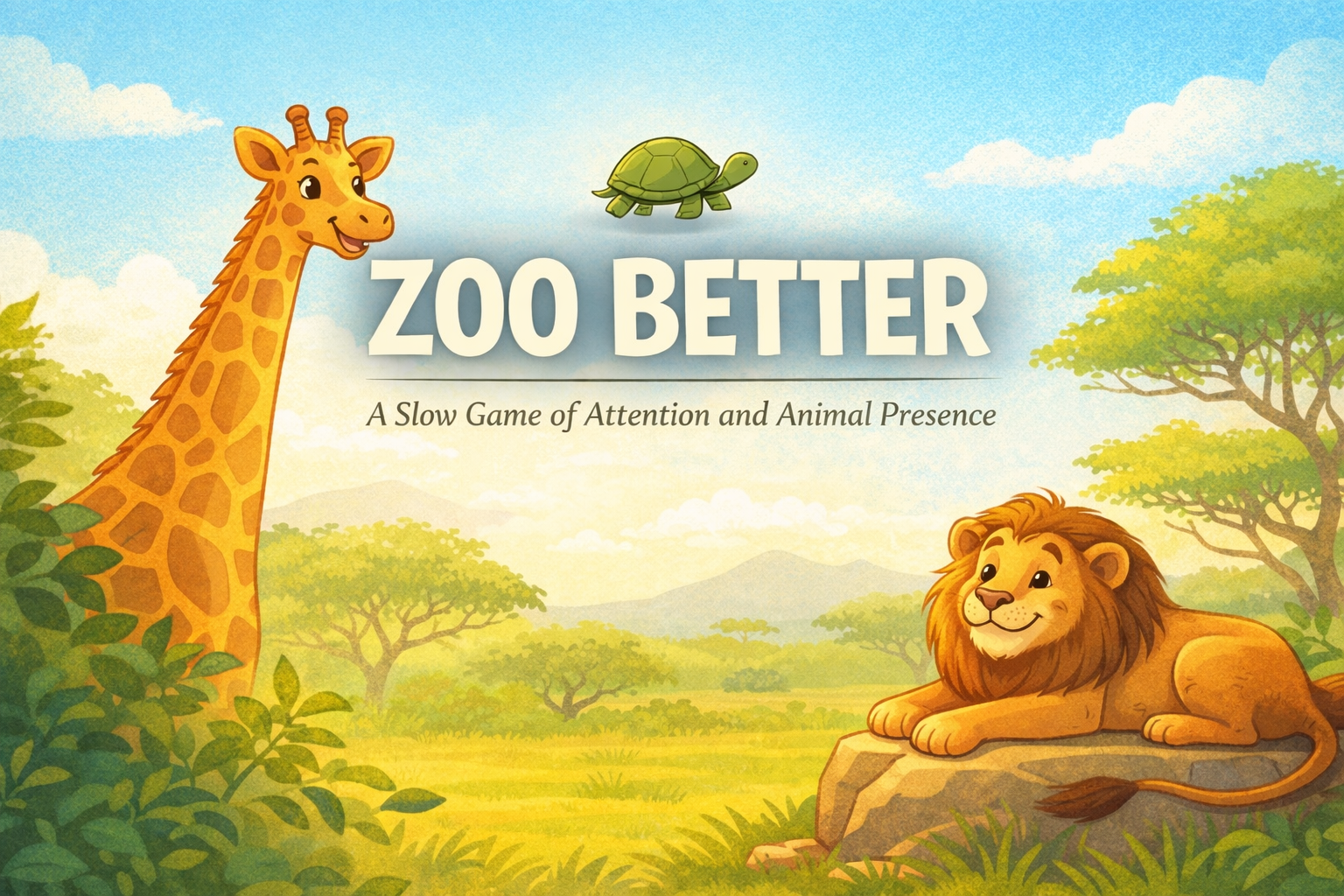
🦒 ZOO BETTER Official Rules & Game Guide A slow game of attention, humility, and animal presence “You don’t visit an animal. You spend time with a neighbor.” WHAT THIS IS Zoo Better is a lo-fi, single-session observation game played inside a zoo or animal sanctuary. Instead of trying to see everything, players choose one animal and stay. This is not education-first. This is not research-first. This is relationship-first. The game only fully reveals itself after you leave. PLAYERS 1 player (recommended) Or 2–3 players playing quietly in parallel This is not a group spectacle. OBJECTIVE (SOFT) To reduce the distance between you and one animal. You do not win by knowing facts. You “win” by noticing patterns. SETUP — CHOOSING YOUR ANIMAL Step 1: Walk the Zoo Once Take a slow lap. Do not stop yet. Do not take notes. Notice: Which enclosures are empty Which animals are passed by Which ones seem patient with being unseen Step 2: Choose One Pick an animal you know little or nothing about. This works best if the animal: Is not crowded Is not a star attraction Does not arrive with expectations This is your animal for the day. DIFFICULTY — SETTING THE DISTANCE Once you’ve chosen your animal, assign it a Difficulty Rating from 1 to 10. 1 means: Easy to watch Active or expressive Immediately readable 10 means: Still, subtle, or distant Easy to overlook Hard to read without time Write this number down. This number represents how far away the animal feels at the start. Your goal is to reduce it. BASE CAMP (OPTIONAL) Set up nearby, within zoo rules: A bench, wall, or patch of shade Notebook or sketchbook Camera (used sparingly) Snacks Binoculars You are not setting up a performance. You are setting up to stay. Sound (Optional) You may bring a musical instrument only if it is: Quiet Simple Easy to stop It may be used: To see if sound changes behavior To match rhythm or pacing To sit with the space and notice response If it feels like playing at the animal instead of staying with it, stop. THE CORE GAME LOOP Zoo Better is played in a loose, repeating loop. You will move through the same phases multiple times during a session. There is no required order. There is no signal when one phase ends and another begins. You may: Observe, then take notes Take notes, then return to watching Make a guess, then abandon it Sit silently longer than expected The loop continues until something changes — usually you. If you feel stuck, return to watching. ⏳ Phase I — Presence Spend uninterrupted time watching. No Googling. No research. No reading plaques beyond basics. Just watch. Let movement repeat. Let stillness stretch. 📝 Phase II — Naturalist Notes Record what you see, not what you think it means. Good notes: “Walks the same path every few minutes” “Freezes when loud voices pass” “Becomes more active after crowds thin” Avoid: “Seems sad” “Looks bored” (Unless clearly marked as a guess.) Sketches and bad drawings encouraged. 🧠 Phase III — Hypotheses At some point, begin making guesses. Label them clearly as HYPOTHESES. Examples: “I think it prefers quiet humans” “I think this is a patrol route” “I think this behavior is play” Do not verify. Do not correct yourself yet. 🌬 Phase IV — Attunement Stay long enough that: Time stretches Movements repeat You stop feeling rushed The animal begins to feel familiar. This phase cannot be rushed. If you leave before this happens, that is part of the score. This is where the game actually happens. ONE ODD RULE You may not name the animal. You may not tell it your name. This is not symbolic. Names end curiosity. ENDING THE SESSION When it feels complete: Acknowledge the end of the interaction without words (standing, leaving your seat, a pause — any nonverbal marker) Pack up Leave the zoo Do not research yet. Let the uncertainty sit. THE DELAYED SCORE Only after leaving the zoo: Research the animal. Compare: What you observed What you guessed What surprised you Now return to your Difficulty Rating. SCORING — REDUCING DISTANCE Subtract 1 point from your Difficulty Rating for each of the following: 🟢 A repeated pattern you noticed that is supported by research 🟡 A wrong hypothesis that sharpened your attention 🔵 Something you noticed that: Isn’t on the signage Isn’t easy to verify Still feels real 🟣 A moment where you caught yourself projecting — and adjusted If other observations feel meaningful and fit the spirit of the game, include them. You may reduce your score below zero. Lower means closer. FINAL SCORE 0 The animal no longer felt distant. Below 0 You noticed more than you expected to. Above 0 There is still distance. That’s normal. There is no maximum score. WIN CONDITIONS (SOFT) You win Zoo Better if: You reach zero —or— You go below it —or— You hesitate before leaving You anticipate a movement before it happens You notice the animal later, unprompted There is no leaderboard. There is no comparison. MODIFIERS Modifiers are optional rule changes that shift how the game feels. They do not make the game harder or easier — just different. 🐢 Parallel Play Multiple players choose different animals. No discussion during observation. Compare notes only after leaving. Notice how attention shapes what each person sees. 🎧 Silent Hour Choose one uninterrupted hour with: No notes No sketches No photos Only watching. Most players find this changes what they notice afterward. 🔁 Return Visit Visit the same animal on a different day. Use the same Difficulty Rating or choose a new one. Notice: What changed What didn’t What was you FINAL NOTE Zoo Better is not about seeing more animals. It is about seeing one animal more clearly than you expected. The animal does not change to fit the game. The distance does. Play slowly. Stay longer than planned. That’s the whole game. 🐢