Duat: Last Voyage of the Pharos
Published 5 June 2026 · On Quisicosas since 6 June 2026
Featured in the newsletter of
6 June 2026 (on Substack)
What it is about
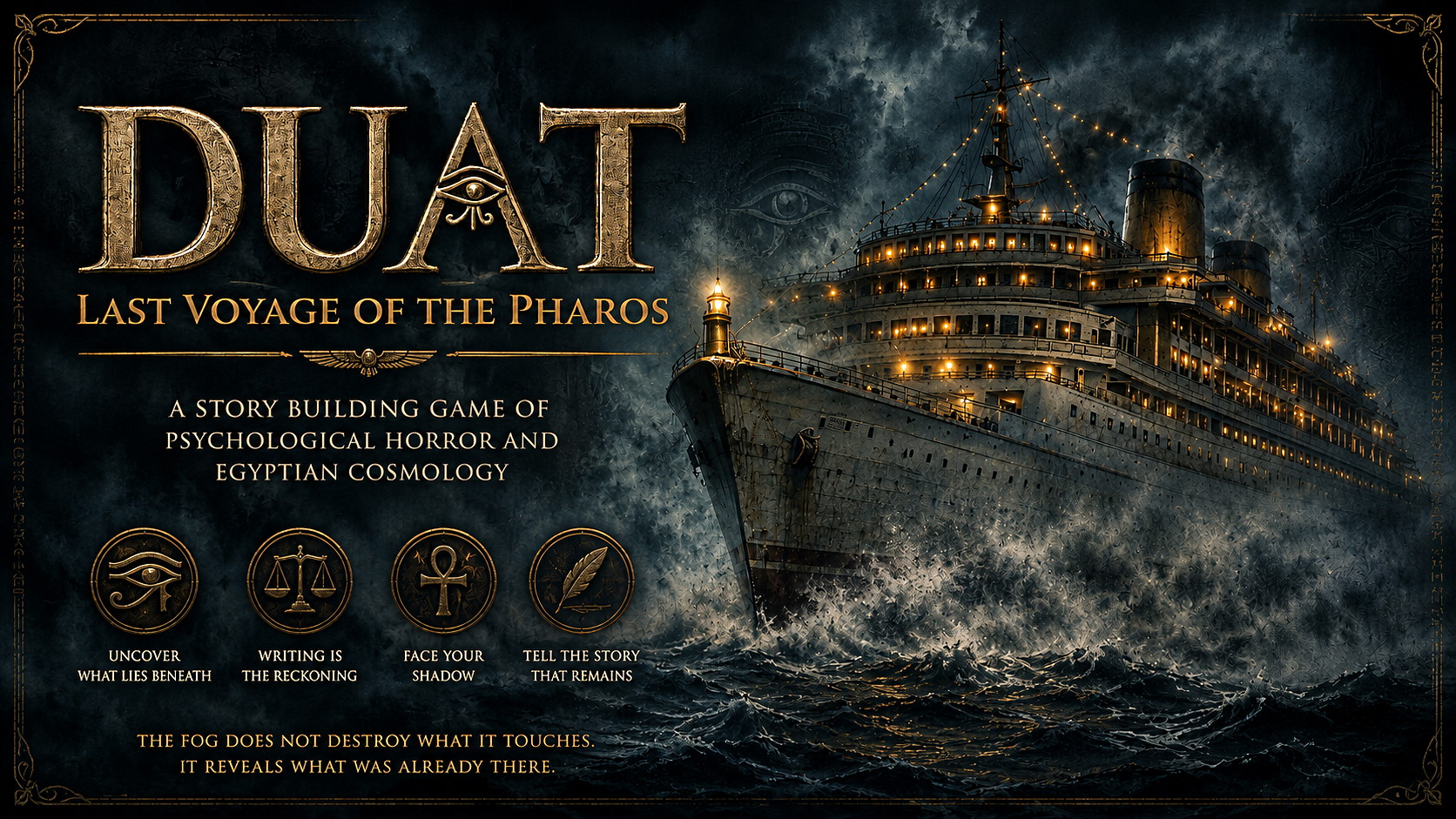
Last Voyage of the Pharos A solo print-and-play journaling game of psychological horror. The MS Pharos of Alexandria sailed from Malaga bound for Alexandria. On the second night, the Duat rose. She did not arrive. You were aboard. What you write is what happened. "The fog does not destroy what it touches. It reveals what was already there." The Voyage The MS Pharos of Alexandria departs Malaga on a clear autumn evening, bound for Alexandria. Among the nine hundred aboard, six passengers are carrying things they have never said aloud. On the second night, the boundary between the living world and the Duat — the Egyptian underworld — fails. The fog rises from below the waterline. The ship does not arrive. You are not a passenger. You are an Akhu: a Egypitan transfigured spirit, one of the imperishable dead, moving unseen through the corridors. You are here to guide. Or to help. Or to harm. The cosmology does not require you to be kind. It only requires you to be present. You will tell five scenes. You will write what you find. Designed by writers and storytellers for promoting the craft What makes this different? Most horror games borrow their dread. Duat does something else. Cosmology, not flavor. The game's mechanics are anchored in the Egyptian soul: Ba (the face shown), Ab (the moral heart), Akh (the transfigured intellect), Ka (vital force), Khaibit (the shadow that follows), Ren (the true name). These are not decoration. They are the system. The Cosmology Guide that ships with the game cites Hornung, Faulkner, Budge, Žabkar, and Assmann — scholarship that has shaped Egyptology for a century. What you read in those margins makes the cards stranger, and more precise. Beyond prompt-based play. This game does not ask "what happens next?" and leave you with a blank page. The CALENA framework — Characters, Activities, Locations, Events, Narrative, Arc — gives you structure, context, and the quiet pressure of a story already in motion. Each scene is built from three drawn cards and a backbone honed over more than two years of work with practicing writers. Sagely advice, baked into the cards. CALENA was refined from 2024 through 2026 with storytellers and published authors from the Horror Writers Association (Halloween in July), Dread Writers Society, the Romance Writers Association (Annual Conference), and the Mystery Writers of America (SleuthFest). It has been presented as a writing instrument — first a writing instrument, second a game — at the Texas Storytelling Festival and the National Storytelling Conference. The guidance on each card is the kind that working authors pass to one another across a table. “I’m always interested in the places where storytelling evolves beyond the page, and DUAT · Last Voyage of the Pharos feels like one of those strange, beautiful intersections. It’s part solo journaling game, part writing ritual, part speculative descent into secrets, memory, and consequence.
Players board the doomed MS Pharos of Alexandria , choose an Anchor character, and follow a five-scene voyage shaped by cards, prompts, and reflection. What unfolds is not just a game session, but a complete story record that is intimate, eerie, and personal each time. What I love most is that DUAT doesn’t just ask us to read a story. It invites us to enter one, uncover it, and become responsible for what the fog reveals. For writers, gamers, and readers who love atmospheric speculative work, this is a fascinating experience.” - Angela Yuriko Smith is a two-time Bram Stoker Award–winning author, former president of the Horror Writers Association, and publisher of Space & Time magazine. Horror The register is Shirley Jackson, Richard Matheson, Robert Bloch, and Stephen King: matter-of-fact, declarative. A statement of what is already true, calmly delivered, which you are left to absorb. The Duat reveals. It does not destroy. The disturbing thing about your story will not be that something happened. It will be that something was already true, and the fog only made it visible. Each of the six named passengers carries four Khaibit cards — four possible shadows. Only one is in play during your voyage. The fog has already chosen which part of each person it is going to find. The table has not. The story will be disturbing in proportion to how seriously you take it. What you'll get Your download contains four printable documents, formatted for both Letter and A4: Core Rulebook — Voyage Introduction, the Egyptian Cosmology Guide, Solo Rules (v1.8), an Example Playthrough, Glossary, and full bibliography. Play Kit — Every printable component you need at the table: Passenger Manifest, Ship's Chart, twelve Voyage Sheets (V1A–V12B) for varied replays, Journal Pages, the Khaibit & Shadow Register, a free streaming music playlist, the Voyage Compass, and Pyramid Lots. Educator's Guide — Lesson plans, compliance with national standards, cross-curricular extentions, and discussion frameworks for the secondary and post-secondary classroom. Cosmology Guide, Classroom Edition — A standalone primer on Egyptian soul cosmology and the literary tradition of psychological horror, with full citations and discussion questions. Usable independently of the game. Endless Replayability — Six Anchors. Twenty-four shadow secrets. Seventy-nine Voyage Sheet pairings. More than three hundred (300) unique story configurations — an eternity to reveal the horror you have always wanted to read. You will also need a pen, a four-sided die (or the printed Pyramid Lots), and roughly seventy-five uninterrupted minutes per voyage. Read the example playthrough for an idea on how Duat can improve your craft and grow your skills. Download the free example walkthrough below — An Eternity of Truth — a complete five-scene voyage by the designer, with every card draw and after-scene reflection shown alongside the prose. It is both a finished story to read and a craft document to study, demonstrating how Duat builds psychological horror in the Jackson–Matheson register one card at a time. Read the example. If it speaks to you, the full game is here. For solo adult writers This is for the player who wants to write the kind of psychological horror they would want to read. A pen. A journal. Seventy-five quiet minutes. Six passengers, each with a starter life, each with four shadow-cards. The cards are your compass; the framework is your structure; the cosmology is the gravity. You will not be handed a blank page. Five scenes. An Epilogue. The Pharos of Alexandria does not arrive. What happened aboard her is what you have written. Join the community Duat: Last Voyage of the Pharos was born in the Dread Writers Society — a gathering of storytellers, writer's, and poets who find their joy in dread, the macabre, and everything that lingers just beyond the lamplight. Bring an excerpt from your Voyage. Bring a poem. Bring the draft you've been circling for months and can't quite figure out what to do with. The DWS is non-algorithmic, generous with feedback, and gloriously cross-generational — a place where writers of every age, gender, and background sharpen each other's work and cheer each other on. For educators The Educator's Guide is designed for use in secondary and post-secondary humanities classrooms — creative writing, comparative mythology, world religions, English literature, gothic studies. The Cosmology Guide Classroom Edition can be assigned independently of the game as a brief, citation-backed primer on the Egyptian soul and the literary tradition of psychological horror. Lessons are mapped to writing outcomes, not score-keeping. Students engage with primary scholarly sources and the same canonical authors they may already be reading: Jackson, Matheson, Poe, Bloch. Comes with references to State and National English Standards Duat's CALENA Story Creation Framework at Rockwall County Library, Rockwall Texas - August 2025 The physical game — Crowdfunding This solo print-and-play is a complete game. It is also a portal to the physical edition — a solo-to-four-player roleplaying game using the same six passengers, the same ship, the same cosmology, with a deeper expression of the soul-part mechanics, expressed in three levels including the Ka offering, and the Gates of the Duat. Crowdfunding will be produced through TheGameCrafter . Follow this page for campaign updates, behind-the-scenes prototypes, and stretch goals. Explore the Duat with two levels of play - competitive and cooperative 1 to 4 players Content advisory Duat is a psychological horror game that depicts dread, moral exposure, irreversibility, and the consequences of long-held secrets. Themes referenced include grief, complicity, addiction, and isolation. The game does not contain graphic violence, sexual content, or hateful content. A full advisory and a Change Your Story safety mechanic are included in the Core Rulebook. Crisis resources are listed in the rulebook's content notes. Credits Designed and written by Stephen L. Schwartz, Schwartz Games. The CALENA framework was refined in collaboration with the Horror Writers Association, the Romance Writers Association, and the Mystery Writers of America, and has been shared with the storytelling communities of the Texas Storytelling Festival and the National Storytelling Conference. Special thanks to the various published authors at the Dread Writers Society and the Authorunities NeighborHub for their encouragement and support. Egyptian cosmology grounded in the work of Hornung, Faulkner, Budge, Žabkar, Assmann, Friedman, Meltzer, and Teeter. Literary register grounded in Jackson, Matheson, Bloch, King, Poe, James, and Highsmith. Full bibliography in the Core Rulebook. © 2026 Stephen L. Schwartz. All rights reserved.